Stakeholder
Clarify the company policy of "Anti-Corruption" and policy at work, recognizes and follows the Enforcement of the Foreign Corrupt Practices Act (FCPA) and laws of R.O.C.. Non-arm's length transactions shall be prohibited. Improper channeling of profits is strictly prohibited.
Stakeholder Grievance hotline: 0800-588-100 Beryl Chang
Anti-corruption e-mail: anti-corruption@shinkong.com.tw

-
ChairpersonTong-Sheng WuExecute all the company's affairs in accordance with the provisions of laws and regulations and the resolutions of the shareholders' meeting and the board of directors, and take overall responsibility for the operation and decision-making of the company and all related companies.
-
Vice ChairpersonHsin-Chieh WuAssist the chairman in carrying out all the affairs of the company in accordance with the provisions of laws and regulations and the resolutions of the shareholders' meeting and the board of directors.
-
Resident DirectorHuo-Tsao ShihIn view of the Company’s increasingly diversified industry investments, assist in handling major projects of the Company in accordance with applicable laws, the Articles of Incorporation, and resolutions of the shareholders’ meeting and the Board of Directors.
-
General manager/presidentChin-Ta Ou
- Resolution of the board of directors, operation and management of the company.
- The company's business philosophy, reform and goals.
- Supervise the formulation and implementation of the quality system to achieve the quality policy and objectives.
- The planning and promotion of management policies, systems, and projects, as well as spot checks on actual implementation results.
- Anti-Corruption Management Policy(99-11-16)
- Articles of Incorporation-1140527
- Audit Committee Charter
- Business Ethics Management Procedures
- Code of Ethical Conduct and Integrity Management
- Code of Ethical Conduct(110-5-28)
- Corporate Governance Best Practice Principles
- Procedures and Guidelines for Ethical Conduct and Integrity Management
- Procedures for Acquisition or Disposal of Assets(111-5-30)
- Procedures for Election of Directors
- Procedures for Endorsements and Guarantees(108-5-29)
- Procedures for Handling Material Inside Information-1111107
- Procedures for Lending of Funds to Others
- Regulations for the Prevention of Insider Trading
- Rules Governing the Establishment and Exercise of Powers of the Compensation Committee
- Rules of Procedure for Board of Directors Meetings(113-05-07)
- Rules of Procedure for Shareholders’ Meetings
- Sustainable Development Best Practice Principles
- Whistleblower Protection and Anti-Retaliation Management Procedures
- Whistleblowing Complaints Suggestions and Employee Participation & Feedback Management Procedure
Internal Audit
- The Company’s internal audit function is an independent unit that reports directly to the Board of Directors. In addition to presenting reports at regular board meetings, the internal audit unit also reports to the Chairperson on a regular basis or as necessary.
- The Internal Audit Charter clearly stipulates that internal audit reviews the internal control systems over the Company’s operating procedures and reports on whether such controls are properly designed and effectively and efficiently implemented. The scope of internal audit covers all operations of the Company.
- Audit activities are primarily carried out in accordance with the audit plan approved by the Board of Directors. The audit plan is formulated based on identified risks. Special audits or reviews may also be conducted when necessary. Through the execution of both routine audits and special audits, internal audit provides management with an overall understanding of the effectiveness of internal control operations and serves as an additional channel for management to promptly identify existing or potential deficiencies.
- The internal audit unit also reviews the self-assessments conducted by various departments, including verifying whether procedures have been properly implemented and reviewing related documentation to ensure the quality of execution. The consolidated results of such self-assessments are reported to the Board of Directors.
- The Company’s internal audit unit is staffed with full-time internal auditors. The appointment, dismissal, and performance evaluation of internal audit personnel are proposed by the head of internal audit and approved by the Chairperson.
Audit (and Risk Management) Committee, Sustainability Development Promotion Committee, and Compensation Committee
Committee Members Hsien Der Chiu/ Chairperson of Xin Hong Construction Co., Ltd.- Experience:
- practicing lawyer
Yung-Ching Tsai/Consultant of Shin Kong Chao Feng Co., Ltd.
Director of U-P Human Resources Consulting Co., Ltd.
Vice-President of Chia Pang Investment Co., Ltd.
- Experience:
- Manager of Finance Department of Shin Kong Life Insurance Co., Ltd.
- Assistant Vice President of General Affairs Department of Shin Kong Life Insurance Co., Ltd.
- Director of Digilife Technologies Co., Ltd.
- Independent director of Advanced Green Biotechnology Inc.
Huei-Huang Lin/Full-time visiting professor
- Experience:
- Deputy Minister, Ministry of Justice
- Chief Prosecutor, Supreme Prosecutors Office
- President, Judges Academy, Ministry of Justice
- Director-General, Department of Protection, Ministry of Justice
- Chief Prosecutor, Hualien District Prosecutors Office
- Chief Prosecutor, Penghu District Prosecutors Office
- Full-time Visiting Professor, College of Law, Shih Hsin University
- Adjunct Professor, Graduate Institute of Law, National Taipei University
1、Committee Structure and Responsibilities
The Company has established the Audit (and Risk Management) Committee, the Compensation Committee, and the Sustainability Development Promotion Committee. Each committee, including other functional committees, is composed of the Company’s three independent directors. Independent Director Hsien-Der Chiu serves as the Convener, with the other two independent directors acting as committee members.
These committees supervise the formulation and implementation of policies related to sustainability development, risk management, and other key governance matters. Task forces are established under each committee, which are required to report at least once a year to the functional committees and the Board of Directors on the status of sustainability policy implementation, risk assessment results and corresponding mitigation measures, as well as stakeholder communication.
2、Audit (and Risk Management) Committee The Audit (and Risk Management) Committee reviews the Company’s financial reports, evaluates the effectiveness of internal control systems, reviews audit fees, amendments to procedures for acquisition or disposal of assets, endorsements and guarantees, loans of funds to others, proposals for annual earnings distribution, and major asset acquisition or disposal matters. After deliberation, all proposals were approved without objection.
The Company’s risk management oversight is incorporated into the responsibilities of the Audit (and Risk Management) Committee. In accordance with the principle of materiality, the Committee supervises sustainability development and risk management policies and their implementation, including the formulation, review, and adjustment of management policies, strategies, and objectives.
Task forces under the Committee consolidate the results of sustainability policy implementation, risk identification, analysis, assessment, and response measures, as well as stakeholder communication outcomes, and report to the Committee and the Board of Directors at least once a year.
Pursuant to the Company’s “Risk Management Policies and Procedures,” the consolidated results of company-wide risk identification, analysis, and assessment were reported to the Committee and the Board of Directors on November 10, 2025. After review and deliberation, all matters were approved without objection
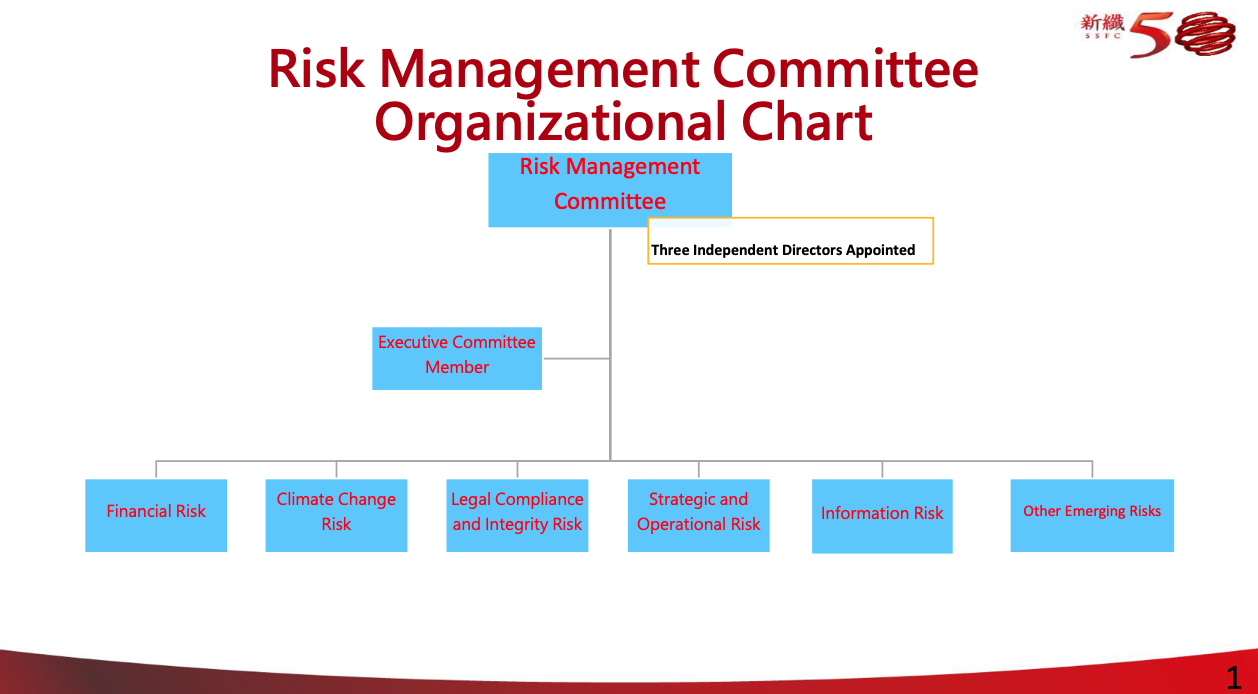 Shinkong Synthetic Fibers Corporation Sustainable Development Committee Organizational Charte_word2pdf
3、Compensation Committee
The Compensation Committee reviews the allocation of employee remuneration and directors’ compensation, the distribution of annual performance bonuses, the reasonableness of salary adjustment proposals, and amendments to bonus-related policies and systems. After explanations were provided by the proposing units, all proposals were approved by the Committee members following discussion, without objection.
4、Sustainability Development Promotion Committee
The Sustainability Development Promotion Committee is composed of the Company’s three independent directors. Independent Director Hsien-Der Chiu serves as the Convener, with the other two independent directors acting as committee members. In accordance with the principle of materiality, the Committee supervises the formulation and implementation of policies related to sustainability development and risk management, including the establishment, review, and evaluation of management guidelines, strategies, and objectives.
Task forces are established under the Committee. At least once a year, these task forces report to the functional committees and the Board of Directors on the implementation status of sustainability policies, risk assessment results and corresponding mitigation measures, as well as stakeholder communication.
The Committee reviews the Company’s sustainability development policies, annual plans and strategies, implementation status and performance of sustainability initiatives, supervises sustainability-related information disclosure, reviews sustainability reports, and oversees the planning and execution of the Company’s sustainability development activities.
On August 4, 2025 and November 10, 2025, the proposing units reported to the Sustainability Development Promotion Committee on the Company’s sustainability development policies and implementation status, sustainability information disclosure and sustainability reports, as well as stakeholder communication progress. In addition, senior management performance indicators were incorporated into the Company’s ESG metrics, including corporate integrity, operational performance, carbon reduction and net-zero initiatives, renewable energy usage, and the promotion of diversity and inclusion.
After review and deliberation by the Committee members and the Board of Directors, all proposals were approved without objection. (For details of the “Resolutions of the 2025 Sustainability Development Promotion Committee,” please refer to the link at the bottom of the webpage.)
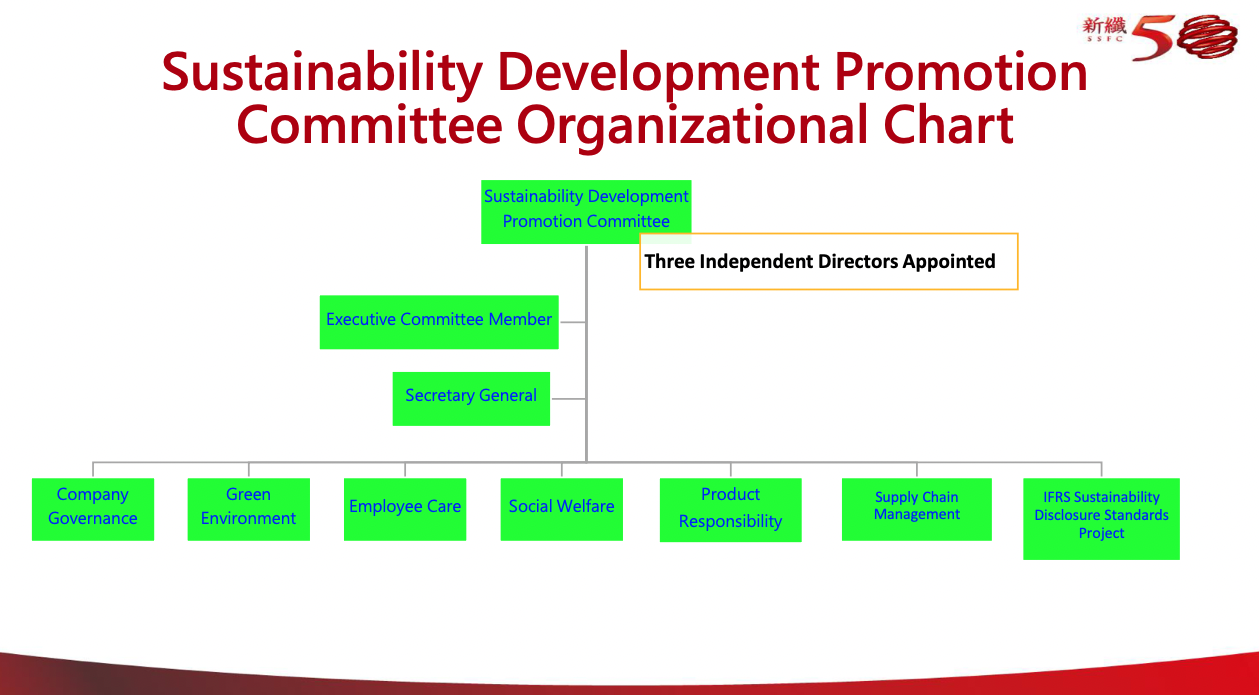 Resolutions of the Audit Committee for Fiscal Year 2025 (ROC Year 114)114年審計委員會決議事項_英文版
Resolutions of the Remuneration Committee for Fiscal Year 2025 (ROC Year 114)114年薪資報酬委員會決議事項_英文版
Resolutions of the Sustainable Development Promotion Committee for Fiscal Year 2025 (ROC Year 114)
On which exchange is Shin Kong Synthetic Fiber stock listed? What is the stock code?
Shin Kong Synthetic Fiber Co., Ltd. was listed on the Taiwan Stock Exchange on August 21, 1973. The stock code on the Taiwan Stock Exchange is 1409
What is the fiscal year of Shin Kong Synthetic Fibers Corporation?
The Company adopts the calendar year as its fiscal year, which runs from January 1 to December 31 each year.
How can investors obtain the Company’s annual reports?
Annual reports can be downloaded from the Company’s website under Investor Relations → Annual Reports, or from the Taiwan Stock Exchange’s Market Observation Post System (MOPS).
How can investors obtain the Company’s historical financial information?
The Company discloses its audited historical financial statements on its website under Investor Relations → Quarterly Financial Reports.
Investors may download the required financial information from this section.
Investors may download the required financial information from this section.
What is the Company’s dividend policy?
If the Company records profits in a given fiscal year, after paying all applicable taxes and offsetting accumulated losses from prior years, 10% of the remaining earnings shall be appropriated as legal reserve, unless the legal reserve has reached the amount of paid-in capital, in which case further appropriation is not required.
Thereafter, special reserves may be appropriated or reversed in accordance with laws and business needs. From the remaining earnings, not less than 1% shall be allocated as employee bonuses and no more than 5% as directors’ remuneration. The remaining balance, together with retained earnings from prior years, shall be used first to distribute cash dividends to preferred shareholders, followed by dividends to common shareholders. The amount of such distribution shall be resolved by the shareholders’ meeting.
Considering that the Company operates in a growing business environment, it aims to achieve sustainable operations and long-term development by taking into account overall economic conditions. When proposing earnings distribution, the Board of Directors places emphasis on the stability and growth of dividends, taking into consideration the Company’s financial condition. Dividends may be distributed in the form of cash dividends and/or stock dividends. The cash dividends distributed to common shareholders shall not be less than 20% of the total dividends payable to common shareholders for the year.
Thereafter, special reserves may be appropriated or reversed in accordance with laws and business needs. From the remaining earnings, not less than 1% shall be allocated as employee bonuses and no more than 5% as directors’ remuneration. The remaining balance, together with retained earnings from prior years, shall be used first to distribute cash dividends to preferred shareholders, followed by dividends to common shareholders. The amount of such distribution shall be resolved by the shareholders’ meeting.
Considering that the Company operates in a growing business environment, it aims to achieve sustainable operations and long-term development by taking into account overall economic conditions. When proposing earnings distribution, the Board of Directors places emphasis on the stability and growth of dividends, taking into consideration the Company’s financial condition. Dividends may be distributed in the form of cash dividends and/or stock dividends. The cash dividends distributed to common shareholders shall not be less than 20% of the total dividends payable to common shareholders for the year.
Can shareholders exercise their voting rights at the Annual General Meeting by written or electronic means?
Shareholders attending the Annual General Meeting may exercise their voting rights by written or electronic means.
For electronic voting, please log in during the designated voting period to the “Shareholder e-Voting” platform operated by Taiwan Depository & Clearing Corporation (TDCC) and cast your vote in accordance with the relevant instructions.
Website: www.stockvote.com.tw
For electronic voting, please log in during the designated voting period to the “Shareholder e-Voting” platform operated by Taiwan Depository & Clearing Corporation (TDCC) and cast your vote in accordance with the relevant instructions.
Website: www.stockvote.com.tw
Who is the contact window for Shinkong Synthetic Fibers Corporation’s shareholder services?
You may contact the Shareholder Services Agency Department of Shinkong Securities Co., Ltd. by phone.
Address:
11F., No. 66-1, Sec. 1, Chongqing South Road, Taipei City, Taiwan
Website:
www.skis.com.tw
Tel:
+886-2-2311-8787
Address:
11F., No. 66-1, Sec. 1, Chongqing South Road, Taipei City, Taiwan
Website:
www.skis.com.tw
Tel:
+886-2-2311-8787
Board Members – Qualifications and Independence (Directors)
| Criteria Name | Professional Qualifications and Experience | Independence Situation | Number of Positions as Independent Director in Other Public Companies |
|---|---|---|---|
| Chairperson Tong-Sheng Wu |
He has a PhD in Law from Harvard University, USA, and is deeply involved in the fields of optoelectronic materials, finance, securities, and department stores, and is committed to promoting the Company's innovative development and global deployment. Chairperson Wu has an international market perspective, leadership skills, decision-making ability, crisis management ability, operational judgment ability, and business management practice ability. |
|
0 |
| Vice Chairperson Hsin-Chieh Wu |
Graduated from Columbia University, USA, with majors in Psychology and Economics. Vice Chairperson Wu is currently the Chairperson of Ubright Optronics Corporation, Director of Shinkong Materials Technology Co., Ltd., and Director of Zacros Group. He has profound professional knowledge and influence in the optoelectronics and technology industries, and promotes related companies’ technological innovation and market expansion. He has operations judgment ability, accounting and financial analysis ability, crisis management ability, industry knowledge, international market perspective, and decision-making ability. |
|
0 |
| Director Shih-Fen Lin |
She graduated from Northwestern University School of Law, LL.M.,USA and is currently an Executive Director of Konig Foods Co., Ltd. with extensive practical experience in the food industry, and has a sharp insight into market trends, product development and supply chain management. As a Director of Optimax Technology Corporation, she is also involved in business management in the technology industry. Director Lin, combining his professional knowledge and experience in law, food industry and technology industry, has demonstrated the integration ability across different fields, and offers long-term support for legal compliance, business management, and long-term strategic development. She has operations judgment ability, business management ability, international market perspective, and decision-making ability. | Direct Lin is the representative of Shin Kong Development Co., Ltd., the Company’s corporate director. | 0 |
| Director Hsing-En Wu |
Graduated from University of California, Los Angeles, USA, and has a master's degree from its Institute of Material Science. He is currently the Chairperson of Shinkong Textile Co., Ltd. and Shinkong Asset Management Co., Ltd., and also the Director of Worthy Textile Industry Co., Ltd. Director Wu has demonstrated his ability in industrial development, business management and asset management. He has operations judgment ability, business management ability, industry knowledge, international market perspective, leadership skills, and decision-making ability. |
|
0 |
| Director Steve Hong |
He graduated from the Department of Information Engineering, University of Minnesota, with a professional background in information technology. He is currently the Director of Han Lin Construction Co., Ltd. and Han Shan Construction Co., Ltd. Director Hung's strategic planning and promotion of enterprises’ steady development in terms of construction development and business operations has injected innovative energy to the diversity of the industry. He possesses operations judgment ability, business management ability, crisis management ability, international market outlook, leadership skills, and decision-making ability. |
|
0 |
| Director Ching-Chun Chiu |
He has a master’s degree in international management from University of St. Thomas, USA, and was the County Chief of Hsinchu County twice (16th and 17th terms). He was also elected as a legislator. At present, he is the President of the World Hakka Federation, Director of Hsinchu Gas Co., Ltd., and Director of Taiwan Flower Biotechnology Co., Ltd. Director Chiu can link the government, enterprises, and international society with his experience in politics, and provides benefits to the diversification of director structure and provide multi-level decision-making opinions. He possesses crises management ability, international market insights, leadership skills, and decision-making ability. | Director Chiu is the representative of the Company’s Corporate Director Tay Way Enterprise Co., Ltd. | 0 |
| Director Hsiu Hui Cheng |
She graduated from Northwestern University School of Law, LL.M.,USA and previously a lawyer at Chien Yeh Law Offices, a visiting lecturer at the Institute of Intellectual Property and Communication Technology Law, Shih Hsin University, and an independent director of Tiancong International Co., Ltd., She currently serves as a attorney at Via Justice Law Offices, a supervisor of the Taiwan Kangning Social Welfare Association, a supervisor of Shinshin Capital Co., Ltd. and an independent director of Trans-Sun Materials Technology Co., Ltd. Ms. Zheng's professional background in legal practice and legal administration will enhance the quality of corporate governance and compliance of the Board of Directors. She has the ability to handle crises, international market insights, leadership ability, and decision-making ability. | Director Cheng is the representative of the Company’s Corporate Director Tay Way Enterprise Co., Ltd. | 0 |
| Director Jung-Chi Liu |
He graduated from the Department of Administrative Management, National Chung Hsing University, with professional background in administrative management and organizational operation ability. He served as an Assistant Vice President of the Company, focusing on the optimization of corporate operation and strategic planning. He also served as the General Manager of the Company’s subsidiary Hangzhou Huachun Chemical Fiber Co., Ltd. (HZC) and currently serves as an consultant of the Shin Kong Wu Ho-Su Memorial Hospital. He offers experience in business management and development, and possesses operations judgement ability, accounting and financial analysis ability, business management ability, crisis management ability, industry knowledge, and decision-making ability. | Director Liu is the representative of the Company’s Corporate Director Mian Hao Enterprise Co., Ltd. | 0 |
| Independent Director Hsien-Der Chiu |
He graduated from the Department of Law, National Taiwan University, has profound legal professional knowledge, and has accumulated abundant practical experience in law as a professional attorney. Director Chiu not only specializes in the legal field, but also combines his legal expertise with business intelligence to work cross-filed in corporate management. He is currently the Chairperson of Xin Hong Construction Co., Ltd., and has management ability, crisis management ability, leadership skills, and decision-making. ability Although he has served as an Independent Director for three terms (9 years), he has not violated any conditions specified in Article 30 of the Company Act. | The three Independent Directors listed on the left have met the qualifications set forth in the "Regulations Governing Appointment of Independent Directors and Compliance Matters for Public Companies" and Article 14-2 of the Securities and Exchange Act during the two years prior to being elected and during the term of office. The Independent Directors have also been granted the right to participate in decision-making and express opinions in accordance with Article 14-3 of the Securities and Exchange Act, in order to perform their duties independently. | 0 |
| Independent Director Huei-Huang Lin |
Juris Doctor, Duke University, USA. He was Deputy Minister of the Ministry of Justice, Director of the Supreme Prosecutor Office, Distinguished Professor, Soochow University College of Law, Chairperson of He Feng Media Investment Co., Ltd., and Director of Asia Satellite Television Co., Ltd. Director Lin provides a diversified background in legal practice, legal administration, media management and academic education, which will improve the quality of corporate governance and compliance of the Board of Directors. He has the ability to handle crises, international market insights, leadership ability, and decision-making ability. The current term of office of the independent director is the second term, less than three terms, and no violation of Article 30 of the Company Act. | 0 | |
| Independent Director Yung-Ching Tsai |
He graduate from the Department of Banking and Insurance, Takming University of Science and Technology, with professional knowledge in accounting and finance. He worked as the Manager of Finance Department, Shin Kong Life Insurance, a Consultant of Shin Kong Chao Feng Co., Ltd., Deputy General Manager of Chia-Bang Investment Co., Ltd., and Director of Shining Human Resource Consulting Co., Ltd. He has the analysis and management ability in finance, accounting, business affairs, investment, and human resources, which will improve the quality of corporate governance of the Board of Directors and the supervisory function of the Audit Committee. He has the operations judgment ability, accounting and financial analysis ability, business management ability, crisis management ability, and decision-making ability. Although he has served as an Independent Director for three terms (9 years), he has not violated any conditions specified in Article 30 of the Company Act. | 0 | |
| Independent Director Chin-Yen Wang |
Master of Business Administration in Human Resource Management from National Central University, previously served as a Practicing Accountant at Deloitte & Touche. Currently, she is the CPA at Hao Yu Accounting Firm, an independent director of Taipei Star Bank, an independent director of Leatec Fine Ceramics Co., Ltd. and an independent director of Cyber Power Systems, Inc. She possesses analytical and management skills in finance, accounting, and the human resources market, which will enhance the corporate governance quality of the board of directors and the oversight function of the audit committee. She also possesses operational judgment, accounting and financial analysis skills, business management skills, crisis management skills, and decision-making abilities. she has not violated any conditions specified in Article 30 of the Company Act. | 3 |
Note: None of the Company’s directors have been found to have any circumstances in Article 30 of the Company Act.
Diversity and independence of the board of directors
(1) Diversity of the board of directors:
A. The Company has established a policy of board diversity and specific management goals: Article 20 (Capabilities that the Board of Directors should have as a whole) of the Company's “Corporate Governance Best-Practice Principles” states:
The composition of the board of directors shall take diversity into consideration. Except that the number of the directors serving concurrently as the managerial officers of the Company shall not exceed one-third of the number of director seats. The board shall develop an appropriate policy for diversification in consideration of its operation, business pattern, and development needs. It is advisable to include, but not limited to, the standards for the following two major aspects:
a. Basic conditions and values: gender, age, nationality, and culture, etc.
b. Professional knowledge and skills: professional background (such as law, accounting, industry, finance, marketing, or technology), professional skills, and industrial experience.
B. The specific management objectives of the Company's diversification policy and the achievements are as follows:
| Management Goals | Status of Achievement |
|---|---|
| The number of Independent Directors shall not be less than one-third of the total number of Directors. | Additional seats will be elected in 2029 |
| At least one of the board members shall be a director of a different gender. | Achieved |
| The Board of Directors is composed of at least one-third of the members of different genders. | Female director seats will be increased in the 2029 re-elections. |
| The majority of the independent directors shall not be re-elected for more than 3 terms in a row. | Achieved in the re-election in 2029 |
| None of the Independent Directors shall serve for more than 3 terms of office consecutively. | Achieved in the re-election in 2029 |
| Among the independent directors, at least one holds the qualifications of certified public accountant, finance, or business administration | Achieved |
| The number of directors who also serve as the Company's managerial officers does not exceed one-third of the total number of directors | Achieved |
(2) Members of the board of directors shall generally possess the necessary knowledge, skills, and literacy to perform their duties. In order to achieve the ideal goal of corporate governance, the board of directors as a whole shall have the following capabilities:
(1) Operational judgment ability (2) accounting and financial analysis ability (3) operation and management ability (4) crisis management ability (5) industry knowledge (6) international market outlook (7) leadership ability (8) decision-making ability.
(3) Current achievement status of board diversity:
A. Basic conditions and values: gender, age, nationality and culture
The Company’s Board of Directors consists of 12 seats, including 4 independent directors and 8 non-independent directors. All directors hold esteemed reputations within the industry. The Company values the gender equality of the composition of the Board of Directors. There is currently three female director, and the Company continues to actively recruit female directors. However, there are not many female directors in the Group's diversified industries, and it is not easy to find suitable female candidates who are female directors of the Group, or who also serve as directors or independent directors.
To achieve the goal of diversification of directors, the goal of the Company's next director re-election in 2029 is to have female directors accounting for one-third of the total directors, and the Company will actively strive to achieve female directors accounting for more than one-third of the Board of Directors in 2029.
B. Professional knowledge and skills: professional background, professional skills and industrial experience
a. General board members:
PhD in Law, Harvard University, USA; Department of Psychology/Economics, Columbia University, USA.; Northwestern University School of Law, LL.M. ,USA; Master of Accounting, Western Illinois State University.; Master of Department of Applied Physics and Materials Science, California State University, Los Angeles; Department of Information, University of Minnesota; Master of International Business Management, University of St. Thomas, USA; Department of International Trade, Feng Chia University; Department of Mechanical Engineering, National Cheng Kung University; Department of Public Administration, National Chung Hsing University; and other professional backgrounds, professional skills and industrial experience.
b. Independent directors:
Consisted of members with professional backgrounds and professional skills, such as the Department of Law, National Taiwan University; Juris Doctor, Duke University, USA; and Department of Insurance and Financial Management, Takming University of Science and Technology.
c. Please refer to the following table for the board members’ a chievement in diversification.
Board Diversity Implementation Matrix
| Diversified core Name of directo | Basic composition | Industry experience | Professional ability | ||||||||||||||||
|---|---|---|---|---|---|---|---|---|---|---|---|---|---|---|---|---|---|---|---|
| Nationality | Gender | Age | Term of office and seniority as an independent director | Manufacturing | Finance | Purchase and marketing | Banking, insurance and real estate | Business management | Information and technology | Law | Finance and accounting | Risk management | |||||||
| 40 ~ 60 years old | 61 ~ 70 years old | 71 ~ 80 years old | 81 ~ 90 years old | 0 ~ 3 years | 3 ~ 6 years | 6 ~ 9 years | 9 years and above | ||||||||||||
| Chairman
Tong-Sheng Wu |
The Republic of China | Male | V | V | V | V | V | V | V | V | V | ||||||||
| Vice Chairperson Hsin-Chieh Wu |
The Republic of China | Male | V | V | V | V | V | V | V | V | V | ||||||||
| Director Shi-Fen Lin |
The Republic of China | Female | V | V | V | V | V | V | |||||||||||
| Director Steve Hong |
The Republic of China | Male | V | V | V | V | V | V | V | ||||||||||
| Director Ching-Chun Chiu |
The Republic of China | Male | V | V | V | V | |||||||||||||
| Director Hsing-En Wu |
The Republic of China | Male | V | V | V | V | V | V | V | ||||||||||
| Director Hsiu Hui Cheng |
The Republic of China | Female | V | V | V | V | V | ||||||||||||
| Director Jung-Chi Liu |
The Republic of China | Male | V | V | V | V | V | V | |||||||||||
| Independent Director Hsien-Der Chiu |
The Republic of China | Male | V | V | V | V | V | V | V | ||||||||||
| Independent Director Huei-Huang Lin |
The Republic of China | Male | V | V | V | V | V | V | |||||||||||
| Independent Director Yung-Ching Tsai |
The Republic of China | Male | V | V | V | V | V | V | V | ||||||||||
| Independent Director Chin-Yen Wang |
The Republic of China | Female | V | V | V | V | V | V | V | V | |||||||||
The nominee has served three consecutive terms as an independent director of the company. The reasons for nominating him to continue as an independent director are as follows:
Hsien-Der Chiu Independent Director:
A practicing lawyer with legal expertise, possessing business management, crisis management, leadership, and decision-making abilities, he is conducive to strengthening the operation of the board of directors. His professional competence and macro-level thinking can enhance the quality and comprehensiveness of the board's decision-making, and he continuously provides professional advice to the board and plays a supervisory role. Although he has served as an independent director of the company for more than three terms, his role is extremely important to the company's decision-making, hence his nomination as a candidate for independent director.
Yung-Ching Tsai Independent Director:
Possessing professional knowledge in financial accounting and extensive practical experience in finance, his expertise covers areas such as financial accounting, business analysis, investment valuation, and the human resources market. During his tenure, he oversees the operation of the Board of Directors and provides professional financial advice, which substantially contributes to improving corporate governance and the operation of the audit committee. Although he has served as an independent director of the Company for more than three terms, the Company still relies on his independent opinions on various investments, hence his nomination as a candidate for independent director.
(4) Independence of the board of directors:
Among the board members, except for Chairperson Tong-Sheng Wu and Vice Chairperson Hsin-Chieh Wu who are father and son, there are three independent directors, which meets the requirement in paragraph 1, Article 14-2 and paragraph 3, Article 26-3 of the Securities and Exchange Act that the number of independent directors shall not be less than two or one-fifth of the total number of directors. In addition, no more than half of the directors shall have a relationship of spouse or relative within the second degree of kinship.
Corporate Governance Officer
Based on its organizational scale, business operations, and management needs, the Company has appointed one Corporate Governance Officer and assigned several part-time supporting units to handle matters related to corporate governance.
Main Responsibilities of Corporate Governance Personnel
- Provide directors with information required for the performance of their duties
- Handle matters related to meetings of the Board of Directors and shareholders’ meetings in accordance with applicable laws
- Handle company registration and change registration
- Prepare minutes of meetings of the Board of Directors and shareholders’ meetings
- Assist directors in complying with applicable laws and regulations
- Assist directors with onboarding and continuing education
- Report to the Board of Directors on the review results of whether independent directors meet relevant qualification requirements at the time of nomination, election, and during their tenure
- Handle matters related to changes in directors
Scope of Authority, Key Tasks, and Training of the Corporate Governance Officer
The primary responsibilities include handling matters related to meetings of the Board of Directors and shareholders’ meetings in accordance with applicable laws, preparing meeting minutes, assisting directors and supervisors with onboarding and continuing education, providing directors and supervisors with information required for the performance of their duties, assisting directors and supervisors in complying with laws and regulations, and other matters stipulated in the Articles of Incorporation or contracts.
In addition, the Corporate Governance Officer proposes improvement measures for items that have not yet met the Company’s corporate governance evaluation targets, with the aim of further enhancing corporate governance practices. For example, in strengthening the structure and operation of the Board of Directors, the Company will enhance intellectual property management; in improving information transparency, the Company will improve its English-language website and accelerate the disclosure of financial reports.
During the current year, the Corporate Governance Officer completed a total of 12 hours of training, covering topics such as analysis of court rulings related to corporate governance practices, insider trading prevention seminars for 2025, business negotiation skills, and the impact of IFRS Sustainability Disclosure Standards on the Company and corresponding response strategies.
Board Performance Evaluation
The Company adopted the Board Performance Evaluation Procedures upon approval by the Board of Directors in 2019. The procedures specify that evaluations are conducted annually, with the evaluation period from January 1 to December 31, covering both the performance of the Board of Directors as a whole and individual directors. The evaluation methods include internal self-evaluations by the Board and self-evaluations by individual directors. The evaluation results are provided to senior management for reference and reported to the Board of Directors before the end of the first quarter of the following year.
Evaluation Framework
- Evaluation Frequency: Once a year
- Evaluation Period: January 1 to December 31
- Evaluation Scope: Performance evaluation of the Board of Directors and individual directors
- Evaluation Methods: Internal self-evaluation by the Board and self-evaluation by individual directors
Evaluation Content and Results
Board Performance Self-Evaluation:
The evaluation covers participation in company operations, enhancement of board decision-making quality, board composition and structure, director nomination and continuing education, and internal control, comprising a total of 40 questions, each category accounting for 20%. Among the evaluation items, scores for “enhancement of board decision-making quality” and “participation in company operations” were relatively lower.
Individual Director Performance Self-Evaluation:
The evaluation covers understanding of company goals and missions, awareness of directors’ duties, participation in company operations, internal relationship management and communication, professional expertise and continuing education, and internal control, comprising a total of 23 questions. Except for “awareness of directors’ duties” and “internal control,” which each account for 10%, the remaining items each account for 20%. Directors expressed relatively lower satisfaction with the evaluation results for “understanding of company goals and missions” and “participation in company operations.”
Performance Evaluation of Functional Committees
The Company incorporated performance evaluations of functional committees into the Board Performance Evaluation Procedures approved by the Board of Directors in 2019. Evaluations are conducted annually, with the evaluation period from January 1 to December 31, covering the performance of the Audit Committee and the Compensation Committee. The primary evaluation method is self-evaluation by each committee. Evaluation results are provided to senior management for reference and reported to the Board of Directors before the end of the first quarter of the following year.
Evaluation Content and Results
Audit Committee Performance Evaluation:
The evaluation covers participation in company operations, understanding of committee duties, enhancement of committee decision-making quality, committee composition and member selection, and internal control, comprising a total of 25 questions, each category accounting for 20%. The evaluation results indicated that there is room for improvement in “understanding of Audit Committee duties.”
Compensation Committee Performance Evaluation:
The evaluation covers participation in company operations, understanding of committee duties, enhancement of committee decision-making quality, committee composition and member selection, and internal control, comprising a total of 25 questions, each category accounting for 20%. The evaluation results indicated that “participation in company operations” and “understanding of committee duties” could be further strengthened.
Insider Trading Prevention Promotion
On August 6, 2024, the Board of Directors approved revisions to the Company’s Insider Trading Prevention Procedures. During the current year, the Company conducted 30-minute annual insider trading prevention training sessions for a total of 14 current insiders and employees. The training content included insider trading concepts and regulations, legal liabilities related to insider trading, common insider trading practices, regulations governing insider trading by insiders, and relevant corporate governance evaluation indicators.
In addition, on February 3, 2025, the Company issued individual email reminders to insiders, notifying them that they are prohibited from trading the Company’s shares during the blackout periods, including 30 days prior to the announcement of annual financial reports and 15 days prior to the announcement of quarterly financial reports. Individual reminders were also sent by email on April 14, July 16, and October 16 to prevent inadvertent violations of insider trading regulations.
Communication between Independent Directors, the Head of Internal Audit, and External Auditors
The Company’s internal audit unit regularly provides independent directors with internal audit reports and reports the latest audit status through meetings of the Board of Directors. Independent directors may also review the Company’s financial information and operational performance at any time. If independent directors have any questions regarding the Company’s operations, they may communicate with the relevant department heads to conduct reviews and improvements.
With respect to communication with external auditors, if independent directors have any questions regarding the Company’s financial condition or operations, they may communicate with the Company’s external auditors at any time and provide guidance to relevant departments for review and improvement.
Summary of Communication between Independent Directors and the Head of Internal Audit
Summary of Communication between Independent Directors and External Auditors
The Company’s Audit Committee is composed entirely of independent directors. External auditors report quarterly to independent directors on key audit (or review) matters and results related to the Company and its domestic and overseas subsidiaries. The auditors also communicate in detail on whether regulatory amendments have any impact on the Company’s operations or financial condition. When necessary, external auditors may directly communicate with independent directors outside regular meetings. Overall communication has been effective.
The Company’s internal audit unit regularly provides independent directors with internal audit reports and reports the latest audit status through meetings of the Board of Directors. Independent directors may also review the Company’s financial information and operational performance at any time. If independent directors have any questions regarding the Company’s operations, they may communicate with the relevant department heads to conduct reviews and improvements.
With respect to communication with external auditors, if independent directors have any questions regarding the Company’s financial condition or operations, they may communicate with the Company’s external auditors at any time and provide guidance to relevant departments for review and improvement.
Summary of Communication between Independent Directors and the Head of Internal Audit
| Date | Communication Method | Topics Discussed | Communication Results | Attendees |
|---|---|---|---|---|
| 2025/01/20 | Board of Directors Meeting | Internal audit operations report | Independent directors acknowledged the report and raised no specific comments. | Independent Directors Chiu, Lin, Tsai; Head of Internal Audit |
| 2025/03/10 | Audit Committee / Board of Directors | Report on “Self-assessment of Internal Control System” and “Internal Control Statement”; Internal audit operations report | Independent directors reviewed the 2024 internal control self-assessment results, raised no objections, and approved the content of the Internal Control Statement. No specific comments on the internal audit report. | Independent Directors Chiu, Lin, Tsai; Head of Internal Audit; External Auditors |
| 2025/04/08 | Board of Directors Meeting | Amendments to internal control system; Internal audit operations report | Independent directors approved the amendments to the internal control system and raised no specific comments on the audit report. | Independent Directors Chiu, Lin, Tsai; Head of Internal Audit |
| 2025/05/05 | Board of Directors Meeting | Internal audit operations report | Independent directors acknowledged the report and raised no specific comments. | Independent Directors Chiu, Lin, Tsai; Head of Internal Audit |
| 2025/08/04 | Board of Directors Meeting | Internal audit operations report | Independent directors acknowledged the report and raised no specific comments. | Independent Directors Chiu, Lin, Tsai; Head of Internal Audit |
| 2025/11/10 | Audit Committee / Board of Directors | 2026 Audit Plan; Internal audit operations report | Independent directors supported and approved the 2026 audit plan. No specific comments on the internal audit report. | Independent Directors Chiu, Lin, Tsai; Head of Internal Audit; External Auditors |
| Date | Communication Method | Discussion Topic | Communication Outcome | Participants |
|---|---|---|---|---|
| 2024/1/23 | Board Meeting | Internal Audit Business Report | Acknowledged with no specific comments. | Independent Directors & Audit Officer |
| 2024/3/11 | Audit Committee, Board | Internal Control Self-Assessment and Statement | Acknowledged and approved without specific comments. | Independent Directors, Audit Officer & Accountants |
| 2024/5/7 | Board Meeting | Internal Audit Business Report | Acknowledged with no specific comments. | Independent Directors & Audit Officer |
| 2024/8/6 | Board Meeting | Internal Audit Business Report | Acknowledged with no specific comments. | Independent Directors & Audit Officer |
| 2024/11/11 | Audit Committee, Board | 2025 Audit Plan and Internal Audit Business Report | Approved and supported the 2025 Audit Plan. | Independent Directors, Audit Officer & Accountants |
| 日期 | 溝通方式 | 溝通項目 | 溝通結果 | 出席人員 |
|---|---|---|---|---|
| 2023/1/16 | 董事會 | 內部稽核業務報告 | 獨董對於內部稽核業務報告知悉並無特別意見。 | 邱獨董、林獨董、蔡獨董及稽核主管 |
| 2023/3/13 | 審計委員會、董事會 | 「內部控制制度自行評估」及「內部控制制度聲明書」報告內部稽核業務報告 | 針對2022年度內部控制制度自行評估結果與獨董溝通,獨董對於結果知悉並無特別意見,並同意「內部控制制度聲明書」之內容。 獨董對於內部稽核業務報告知悉並無特別意見。 |
邱獨董、林獨董、蔡獨董及稽核主管、查核簽證會計師 |
| 2023/5/10 | 董事會 | 內部稽核業務報告 | 獨董對於內部稽核業務報告知悉並無特別意見。 | 邱獨董、林獨董、蔡獨董及稽核主管 |
| 2023/7/3 | 董事會 | 內部稽核業務報告 | 獨董對於內部稽核業務報告知悉並無特別意見。 | 邱獨董、林獨董、蔡獨董及稽核主管 |
| 2023/7/26 | 董事會 | 內部稽核業務報告 | 獨董對於內部稽核業務報告知悉並無特別意見。 | 邱獨董、林獨董、蔡獨董及稽核主管 |
| 2023/8/7 | 董事會 | 內部稽核業務報告 | 獨董對於內部稽核業務報告知悉並無特別意見。 | 邱獨董、林獨董、蔡獨董及稽核主管 |
| 2023/11/7 | 審計委員會、董事會 | 2024年度稽核計畫 內部稽核業務報告 |
獨董對於2024年度稽核計畫予以支持,並照案通過。 獨董對於內部稽核業務報告知悉並無特別意見。 |
邱獨董、林獨董、蔡獨董及稽核主管、查核簽證會計師 |
Summary of Communication between Independent Directors and External Auditors
The Company’s Audit Committee is composed entirely of independent directors. External auditors report quarterly to independent directors on key audit (or review) matters and results related to the Company and its domestic and overseas subsidiaries. The auditors also communicate in detail on whether regulatory amendments have any impact on the Company’s operations or financial condition. When necessary, external auditors may directly communicate with independent directors outside regular meetings. Overall communication has been effective.
| Date | Topics Discussed | Communication Results | Attendees |
|---|---|---|---|
| 2024/03/11 | 1. Report on audit results and key audit matters for the 2023 consolidated and separate financial statements.
2. Explanation of 2023 financial statements, audit reports, audit quality indicators of the CPA firm, and key audit matters. |
The Audit Committee approved the 2023 consolidated and separate financial statements, which were then submitted to the Board of Directors for approval and duly announced and filed with the competent authorities. | Independent Directors Chiu, Lin, Tsai; External Auditors |
| 2024/05/07 | Report on review results and key review matters of the 2024 first-quarter consolidated financial statements. | The Audit Committee approved the 2024 Q1 consolidated financial statements, which were then submitted to the Board of Directors for approval and duly announced and filed. | Independent Directors Chiu, Lin, Tsai; External Auditors |
| 2024/08/06 | Report on review results and key review matters of the 2024 second-quarter consolidated financial statements. | The Audit Committee approved the 2024 Q2 consolidated financial statements, which were then submitted to the Board of Directors for approval and duly announced and filed. | Independent Directors Chiu, Lin, Tsai; External Auditors |
| 2024/11/11 |
1. Report on review results and key review matters of the 2024 third-quarter consolidated financial statements.
2. Report on key audit matters for the 2024 annual financial statements. |
The Audit Committee approved the 2024 Q3 consolidated financial statements, which were then submitted to the Board of Directors for approval and duly announced and filed. | Independent Directors Chiu, Lin, Tsai; External Auditors |
| 日期 | 溝通項目 | 出席人員 |
|---|---|---|
| 2023/03/13 | 會計師就2022年財務報表及查核報告進行說明。 | 邱獨董、林獨董、蔡獨董及查核簽證會計師 |
| 2023/05/10 | 會計師就2023年第一季財務報表進行說明。 | 邱獨董、林獨董、蔡獨董及查核簽證會計師 |
| 2023/08/07 | 會計師就2023年上半年度財務報表進行說明。 | 邱獨董、林獨董、蔡獨董及查核簽證會計師 |
| 2023/11/07 | 會計師就2023年第三季財務報表及2023年關鍵查核報告事項進行說明。 | 邱獨董、林獨董、蔡獨董及查核簽證會計師 |


Shin Kong Synthetic Fibers Corporation Advocacy Statement
Shin Kong Synthetic Fibers Corporation (“SSFC”) upholds the vision of becoming a high-tech polyester industry driven by sustainable development. Guided by our core values of Sustainable Development, Green Energy & Environmental Protection, and Sincere Care, we strive to provide customers with high-quality products and services. Adhering to the principle of “Pursuing Excellence and Continuous Improvement,” we will continue to enhance our professionalism, launch innovative products, fulfill social responsibilities, and work toward sustainable operations.
Sustainable business operations have long been one of SSFC’s key goals and a driving force for corporate growth. We believe that in-depth communication with stakeholders contributes to corporate sustainability. By listening to the views of employees, customers, suppliers, shareholders, and other stakeholders—and by paying close attention to social and environmental issues, labor and human rights, business ethics, and sustainable procurement—we identify material sustainability topics, formulate goals and action plans, and implement improvement programs step by step. In doing so, we respond to stakeholder expectations, fulfill corporate citizenship responsibilities, and jointly pursue a sustainable future.
SSFC supports internationally recognized human rights standards and principles, including the Universal Declaration of Human Rights, the UN Global Compact, the UN Guiding Principles on Business and Human Rights, and the International Labour Organization (ILO). Full compliance with the laws and regulations of the countries/regions where we operate is a fundamental requirement.
A. Labor
SSFC commits to protecting and respecting the human rights of all workers in accordance with internationally recognized standards. This applies to all workers, including temporary workers, migrant workers, students, contract workers, direct employees, and any other type of worker.
Labor Standards:
-
Freely Chosen Employment:
Forced, bonded (including debt bondage) or indentured labor, involuntary or exploitative prison labor, slavery, and human trafficking are strictly prohibited. This includes the use of intimidation, coercion, threats, abduction, or fraud to transport, harbor, recruit, transfer, or receive workers or services. Workers’ freedom of movement shall not be unreasonably restricted, including within workplaces, dormitories, or living areas.
As part of the recruitment process, all workers must receive a written employment agreement in their native language that describes the terms and conditions of employment. For migrant workers, the employment agreement must be provided before departure from the worker’s country of origin, and must not be replaced or modified upon arrival in the receiving country, except where required by local law and where equal or better terms are provided.
All work must be voluntary. Workers have the right to leave employment freely at any time, and may terminate employment without penalty when reasonable notice is given in accordance with the employment agreement. Employers and agents shall not withhold or otherwise destroy, conceal, confiscate, or deny access to workers’ identity or immigration documents (such as government-issued IDs, passports, or work permits), except where retention is required by law. Even in such cases, workers must have access to their documents at all times.
Workers shall not be required to pay recruitment fees beyond those permitted by the laws and regulations of the sending country and Taiwan. If any such fees are found to have been paid by workers, the fees must be reimbursed to the relevant workers.
-
Young Workers:
Child labor shall not be used in any manufacturing process. “Child labor” refers to employing workers under the age of 15. SSFC shall implement appropriate mechanisms to verify workers’ age. Legitimate workplace learning programs that comply with applicable laws and regulations are excluded.
Workers under the age of 18 shall not perform work likely to jeopardize their health or safety, including night shifts or overtime. SSFC shall properly maintain student records, strictly evaluate educational partners, and protect student rights in accordance with applicable laws and regulations to ensure proper management of student workers. SSFC shall provide appropriate support and training to student workers. Where local law does not specify otherwise, wages for student workers, interns, and apprentices shall be at least equal to those of other entry-level workers performing the same or similar work. If child labor is identified, SSFC will provide assistance and remediation.
-
Working Hours:
Working hours shall not exceed the maximum set by local law. In addition, weekly working hours shall not exceed 60 hours (including overtime), except in emergency or unusual situations. Overtime shall be voluntary. Workers shall be allowed at least one day off every seven days. -
Wages and Benefits:
Wages shall comply with all applicable wage laws, including those related to minimum wage, overtime, and legally mandated benefits. Overtime pay shall exceed the regular hourly rate as required by local law. Wage deductions as a disciplinary measure are prohibited. A clear and timely wage statement with sufficient information to verify accurate compensation must be provided each pay period. Temporary, dispatched, and outsourced workers shall be employed in accordance with local law. -
Humane Treatment:
Harsh or inhumane treatment of employees is prohibited, including violence, sexual violence, sexual harassment, sexual abuse, corporal punishment, mental or physical coercion, bullying, public humiliation, or verbal abuse. Threats of such behavior are also prohibited. Disciplinary policies and procedures shall be clearly defined and communicated to employees. -
Non-Discrimination/Non-Harassment:
SSFC is committed to providing a workplace free from harassment and discrimination. Discrimination or harassment in hiring and employment practices is prohibited based on race, color, age, gender, sexual orientation, gender identity and expression, ethnicity, disability, pregnancy, religion, political opinion, group affiliation, veteran status, protected genetic information, marital status, or other protected characteristics, including in wages, promotions, rewards, and training opportunities. Appropriate facilities shall be provided for religious practices. Discriminatory medical examinations (including pregnancy or virginity tests) and physical examinations shall not be required. -
Freedom of Association:
In accordance with local law, SSFC respects the right of all workers to form and join unions of their choice, engage in collective bargaining, and participate in peaceful assembly, as well as the right to refrain from such activities. Workers and their representatives shall be able to communicate openly with management regarding working conditions and management practices without fear of discrimination, retaliation, threats, or harassment.
B. Health and Safety
SSFC recognizes that a safe and healthy work environment helps minimize work-related injuries and illnesses, improves the quality of products and services, stabilizes production, and strengthens employee morale and loyalty. SSFC also recognizes that ongoing employee engagement and education are key to identifying and addressing health and safety issues in the workplace.
This code references recognized management systems (such as ISO 45001 and the ILO Guidelines on Occupational Safety and Health Management Systems) as useful additional sources of information.
Safety and Health Standards:
-
Occupational Safety
SSFC identifies, evaluates, and mitigates workplace health and safety hazards (e.g., chemical, electrical and other energy sources, fire, vehicles, and slip/fall hazards) through a hierarchy of controls, including hazard elimination, substitution of processes or materials, safe design, engineering and administrative controls, preventive maintenance, safe work procedures (including lockout/tagout), and ongoing safety training. Where hazards cannot be effectively controlled, appropriate and well-maintained personal protective equipment (PPE) and related training materials shall be provided.
Reasonable measures shall be taken to keep pregnant and nursing women away from high-risk work environments, to eliminate or reduce occupational health and safety risks they may face (including risks associated with assigned work), and to provide reasonable accommodations for nursing women.
-
Emergency Preparedness
SSFC identifies and assesses potential emergencies and events and minimizes impacts through emergency plans and response procedures, including emergency reporting, employee notification and evacuation plans, training, and drills. Emergency drills shall be conducted at least annually or as required by local law, whichever is more stringent. Emergency plans shall also include appropriate fire detection and suppression equipment, unobstructed emergency exits, sufficient evacuation facilities, emergency contact information, and recovery plans, with a focus on minimizing harm to life, the environment, and property. -
Occupational Injury and Illness
SSFC establishes procedures and systems to prevent, manage, track, and report occupational injuries and illnesses, including encouraging employee reporting, classifying and recording cases, providing necessary medical treatment, investigating cases and implementing corrective actions to eliminate root causes, and supporting employees’ return to work. -
Industrial Hygiene
SSFC identifies, evaluates, and controls employee exposure to chemical, biological, and physical agents. Where hazards are identified, opportunities to eliminate and/or reduce hazards shall be pursued. Where elimination is not feasible, appropriate design, engineering, and administrative controls shall be used. If such measures cannot effectively prevent hazards, suitable and properly maintained PPE shall be provided free of charge and used. Protective programs shall be ongoing and include training materials on related risks. -
Physically Demanding Work
SSFC identifies, evaluates, and controls hazards associated with physically demanding work, including manual material handling, repeated heavy lifting, prolonged standing, and highly repetitive or high-intensity assembly work. -
Machine Safeguarding
SSFC evaluates safety hazards associated with production equipment and other machinery. To prevent injury, physical guards, interlocks, and barriers shall be provided and properly maintained. -
Sanitation, Food, and Housing
SSFC provides clean restroom facilities, safe drinking water, and hygienic cooking tools, food storage facilities, and utensils. Dormitories provided by SSFC or labor agents shall be clean and safe, and shall include appropriate emergency exits, hot water for bathing, adequate lighting/heating/ventilation, secure storage areas for personal and valuable items, and appropriate and accessible private space. -
Health and Safety Communication
SSFC provides appropriate occupational health and safety information and training in a language employees understand to identify all workplace hazards, including but not limited to mechanical, electrical, chemical, fire, and physical hazards. Health and safety information shall be posted prominently or placed where employees can readily view and access it. All employees shall receive training before starting work and periodically thereafter. Employees shall be encouraged to raise health and safety concerns without fear of retaliation.
C.Environment
SSFC recognizes that environmental responsibility is an essential part of producing world-class products. SSFC identifies the environmental impacts of its manufacturing processes and strives to minimize adverse impacts on communities, the environment, and natural resources while safeguarding public health and safety.
Environmental Standards:
-
Environmental Permits and Reporting
SSFC obtains, maintains, and regularly updates all required environmental permits, approvals, and registrations (such as emissions monitoring), and complies with permit operating and reporting requirements. -
Pollution Prevention and Resource Conservation
SSFC minimizes or eliminates emissions of pollutants and the generation of waste at the source or through practices such as adding pollution control equipment, improving production, maintenance, and facility procedures, or other measures. SSFC also conserves natural resources (including water, fossil fuels, minerals, and virgin forest products) through improved processes, material substitution, reuse, conservation, recycling, or other methods. -
Hazardous Substances
SSFC identifies, labels, and manages chemicals, wastes, and other materials that pose hazards to humans or the environment to ensure they are safely handled, transported, stored, used, recycled/reused, and disposed of. -
Solid Waste
SSFC implements systematic measures to identify, manage, reduce, and responsibly dispose of or recycle non-hazardous solid waste. -
Air Emissions
SSFC characterizes, routinely monitors, controls, and treats air emissions generated from operations (including volatile organic chemicals, aerosols, corrosives, particulates, ozone-depleting substances, and combustion by-products) prior to discharge, as required. Ozone-depleting substances shall be effectively managed in accordance with the Montreal Protocol and applicable regulations. SSFC routinely monitors the performance of air emissions control systems. -
Materials Restrictions
SSFC complies with applicable laws, regulations, and customer requirements regarding the prohibition or restriction of specific substances in products and manufacturing processes, including labeling for recycling and disposal. -
Water Resource Management
SSFC implements water management programs to document, classify, and monitor water sources, usage, and discharge; seek opportunities to conserve water; and control pollution pathways. Wastewater shall be characterized, monitored, controlled, and treated as required before discharge or disposal. SSFC routinely monitors the performance of wastewater treatment and control systems to ensure optimal performance and regulatory compliance. -
Energy Consumption and Greenhouse Gas Emissions
SSFC establishes company-level greenhouse gas (GHG) reduction targets. Energy consumption and related Scope 1 and Scope 2 GHG emissions shall be tracked, recorded, and publicly reported to support achievement of reduction targets. SSFC seeks ways to improve energy efficiency and minimize energy use and GHG emissions.
To fulfill its social responsibilities and achieve success in the market, the company and its agents must adhere to the highest ethical standards, including the following:
-
Business Integrity
The highest standards of integrity shall be upheld in all business interactions. SSFC adopts a zero-tolerance policy prohibiting all forms of bribery, corruption, extortion, and embezzlement. -
Prohibition of Improper Gains
The company prohibits offering, providing, approving, giving, or receiving bribes or other improper benefits. This prohibition includes offering, providing, approving, giving, or receiving anything of value, whether directly or indirectly through third parties, with the intent of securing or retaining business, transferring business to others, or obtaining undue advantages. Monitoring, record-keeping, and enforcement procedures must be implemented to ensure compliance with anti-corruption laws. -
No Improper Advantage
Bribes or other forms of improper benefit shall not be promised, offered, authorized, given, or accepted. This prohibition includes offering or receiving anything of value, whether directly or indirectly through a third party, to obtain or retain business, direct business to any person, or gain an improper advantage. Monitoring, record-keeping, and enforcement procedures shall be implemented to ensure compliance with anti-corruption laws. -
Disclosure of Information
Business dealings shall be transparent, and information regarding labor, health and safety, environmental practices, business activities, organizational structure, financial condition, and performance shall be disclosed in accordance with applicable regulations and prevailing industry practices. Records shall not be falsified, and supply chain conditions or practices shall not be misrepresented. -
Intellectual Property
SSFC respects intellectual property rights. Technology and production know-how shall be transferred in a manner that protects intellectual property, and customer and supplier information must be protected. -
Fair Business, Advertising, and Competition
SSFC adheres to standards of fair business, advertising, and competition. -
Protection of Identity and Non-Retaliation
Unless prohibited by law, SSFC establishes procedures to protect the confidentiality and anonymity of suppliers and employee whistleblowers, and to prevent retaliation. Communication mechanisms shall allow employees to raise concerns without fear of retaliation.
Whistleblower refers to any person who reports misconduct by company employees, supervisors, public officials, or government agencies. -
Responsible Sourcing of Minerals
SSFC adopts a policy and conducts due diligence on the source and supply chain of tantalum, tin, tungsten, and gold contained in its products to reasonably assure consistency with the OECD Due Diligence Guidance for Responsible Supply Chains of Minerals from Conflict-Affected and High-Risk Areas, or an equivalent recognized due diligence framework. -
Privacy
SSFC commits to reasonably protecting personal data and privacy of parties with whom it does business (including suppliers, customers, consumers, and employees). SSFC complies with privacy and information security laws and regulatory requirements when collecting, storing, processing, transmitting, and sharing personal data.
E. Management System
SSFC adopts or establishes a management system relevant to the scope of this Code. The management system is designed to ensure: (a) compliance with applicable laws, regulations, and customer requirements related to SSFC operations and products; (b) compliance with this Code; and (c) identification and mitigation of business risks related to this Code. The management system also promotes continuous improvement.
The management system includes the following elements:
-
Company Commitment
A corporate social and environmental responsibility policy statement shall affirm SSFC’s commitment to legal compliance and continuous improvement, be signed by senior management, and be posted in the workplace in the local language. -
Management Accountability and Responsibility
SSFC clearly assigns senior management and company representatives to ensure implementation of the management system and related programs. Senior management shall regularly review the operation of the management system. -
Legal and Customer Requirements
SSFC establishes procedures to identify, monitor, and understand applicable laws, regulations, and customer requirements (including the requirements of this Code). -
Risk Assessment and Risk Management
SSFC establishes procedures to identify compliance, environmental, health and safety, labor, and ethical risks related to operations; evaluate risk levels; and implement appropriate procedural and physical controls to manage identified risks and ensure regulatory compliance. -
Improvement Objectives
SSFC establishes written performance objectives, metrics, and implementation plans to improve social, environmental, and health and safety performance, including periodic reviews of progress toward these objectives. -
Training
SSFC establishes training programs for management and employees to implement policies, procedures, and improvement objectives, and to meet applicable legal and regulatory requirements. -
Communication
SSFC establishes procedures to clearly and accurately communicate policies, practices, expectations, and performance to employees, suppliers, and customers. -
Employee Feedback, Participation, and Grievance Mechanisms
SSFC establishes ongoing processes (including effective grievance mechanisms) to assess employees’ awareness of practices covered by this Code and of violations or conditions, gather feedback, and promote continuous improvement. Employees shall be provided a safe environment to raise concerns and suggestions without fear of retaliation. -
Audits and Assessments
SSFC conducts regular self-assessments to ensure compliance with laws and regulations, this Code, and social and environmental responsibility requirements in customer contracts. -
Corrective Action
SSFC establishes procedures to ensure timely correction of deficiencies identified through internal and external assessments, inspections, investigations, and audits. -
Documentation and Records
SSFC establishes and retains documentation and records to ensure compliance with regulatory and company requirements while safeguarding privacy and confidentiality. -
Supplier Responsibility
SSFC establishes procedures to communicate the requirements of this Code to suppliers and to monitor supplier compliance with this Code.

Social Responsibility Policy
In order to fulfill corporate social responsibility and ensure that the Company fully considers the impacts of its operations on society, the environment, and the economy, Shin Kong Synthetic Fibers Corporation (“SSFC”) actively implements measures to promote sustainable development. By establishing and implementing an effective social responsibility management system, the Company seeks to ensure that its business activities do not cause negative impacts on employees, suppliers, customers, consumers, or society, and contribute to the achievement of global sustainable development goals.
Scope of Application
Shin Kong Synthetic Fibers Corporation and its subsidiaries.
Compliance Items
-
Labor
- Freely Chosen Employment
- Forced labor, bonded labor (including debt bondage), indentured labor, involuntary or exploitative prison labor, slavery, and human trafficking are prohibited.
- Unreasonable restrictions on workers’ entry to or exit from the workplace are prohibited.
- Workers shall be provided with an employment agreement written in their native language, describing the terms and conditions of employment.
- Employers and labor agents shall not withhold, destroy, conceal, or confiscate workers’ identity or immigration documents.
- Workers shall not be required to pay recruitment fees beyond those permitted under the laws and regulations of the sending country and Taiwan.
-
Youth Workers
- Child labor shall not be used in any manufacturing process. “Child labor” refers to employing any person under the age of 15, below the compulsory education age, or below the minimum employment age in the applicable country/region (whichever is highest).
- The Company shall implement appropriate mechanisms to verify workers’ age. Legitimate workplace learning programs that comply with applicable laws and regulations are excluded.
- Workers under the age of 18 (young workers) shall not perform work that may endanger their health or safety, including night shifts or overtime.
- If child labor is identified, the Company will provide assistance and remediation.
-
Working Hours
- Working hours shall not exceed the maximum limit set by local law.
- Weekly working hours shall not exceed 60 hours (including overtime), except in emergency or unusual situations.
- Overtime shall be voluntary.
- Workers shall be allowed at least one day off every seven days.
-
Wages and Benefits
- Wages shall comply with all applicable wage and compensation laws, including those related to minimum wage, overtime, and statutory benefits.
- Overtime pay shall be higher than the regular hourly wage as required by local law.
- Wage deductions as a disciplinary measure are prohibited.
- A clear and timely wage statement shall be provided each pay period with sufficient information to verify accurate compensation.
-
Humane Treatment
- Harsh or inhumane treatment of employees is prohibited, including violence, sexual violence, sexual harassment, sexual abuse, corporal punishment, mental or physical coercion, bullying, public humiliation, or verbal abuse. Threats of such behavior are also prohibited.
- Disciplinary policies and procedures shall be clearly defined and communicated to employees.
-
Non-Discrimination / Anti-Harassment
- The Company is committed to providing a workplace free from harassment and discrimination.
- Discrimination or harassment in recruitment and employment is prohibited based on race, color, age, gender, sexual orientation, gender identity and expression, ethnicity, disability, pregnancy, religion, political opinion, group affiliation, veteran status, protected genetic information, marital status, or other protected characteristics, including in wages, promotions, rewards, and training opportunities.
- Appropriate facilities shall be provided for religious practices.
- Discriminatory medical examinations (including pregnancy or virginity tests) or physical examinations shall not be required for employees or job candidates.
-
Freedom of Association
- In accordance with local law, the Company respects workers’ rights to form and join unions of their choice, engage in collective bargaining, and participate in peaceful assembly, as well as the right to refrain from such activities.
- Workers and their representatives shall be able to communicate openly with management regarding working conditions and management practices without fear of discrimination, retaliation, threats, or harassment.
- Freely Chosen Employment
-
Health and Safety
-
Occupational Safety
- The Company identifies, evaluates, and mitigates workplace health and safety hazards through a hierarchy of controls, including hazard elimination, substitution of processes or materials, safe design, engineering and administrative controls, preventive maintenance, and safe work procedures (including lockout/tagout), as well as continuous safety training.
- Where hazards cannot be effectively controlled, appropriate and well-maintained personal protective equipment (PPE) shall be provided, together with training materials related to hazards and risks.
- Reasonable measures shall be taken to keep pregnant and nursing women away from high-risk work environments, reduce related occupational health and safety risks, and provide reasonable accommodations for nursing women.
-
Emergency Preparedness
- The Company identifies and assesses potential emergencies and minimizes impacts through emergency plans and response procedures, including emergency reporting, employee notification and evacuation plans, training, and drills.
- Emergency drills shall be conducted at least annually or as required by local law, whichever is more stringent.
- Emergency plans shall include appropriate fire detection and suppression equipment, unobstructed emergency exits, sufficient evacuation facilities, emergency contact information, and recovery plans, with a focus on minimizing harm to life, the environment, and property.
-
Occupational Injury and Illness
- The Company establishes procedures and systems to prevent, manage, track, and report occupational injuries and illnesses, including: encouraging reporting, classifying and recording cases, providing necessary medical treatment, investigating cases and implementing corrective actions, and supporting employees’ return to work.
-
Industrial Hygiene
- The Company identifies, evaluates, and controls employee exposure to chemical, biological, and physical agents through a hierarchy of controls.
- Where hazards cannot be eliminated or sufficiently reduced, appropriate design, engineering, and administrative controls shall be implemented.
- If such measures are not effective, suitable and properly maintained PPE shall be provided free of charge and used. Protective programs shall be ongoing and include training materials on related risks.
-
Physically Demanding Work
The Company identifies, evaluates, and controls hazards associated with physically demanding work, including manual material handling, repetitive heavy lifting, prolonged standing, and highly repetitive or high-intensity assembly work. -
Machine Safeguarding
- The Company evaluates safety hazards associated with production equipment and other machinery.
- Physical guards, interlocks, and barriers shall be provided and properly maintained to prevent injury.
-
Sanitation, Food, and Housing
- The Company provides clean restroom facilities, safe drinking water, and hygienic cooking tools, food storage facilities, and utensils.
- Dormitories provided by the Company or labor agents shall be clean and safe, and shall include appropriate emergency exits, hot water for bathing, adequate lighting/heating/ventilation, secure storage for personal and valuable items, and appropriate and accessible private space.
-
Health and Safety Communication
- The Company provides occupational health and safety information and training in a language workers understand to identify workplace hazards, including mechanical, electrical, chemical, fire, and physical hazards.
- Health and safety information shall be posted in visible areas or placed where workers can easily access it.
- Training shall be provided before starting work and periodically thereafter.
- Workers are encouraged to raise health and safety concerns without fear of retaliation.
-
Occupational Safety
-
Environment
- Environmental Permits and Reporting
The Company obtains, maintains, and regularly updates all required environmental permits, approvals, and registrations (e.g., emissions monitoring), and complies with permit operating and reporting requirements. -
Pollution Prevention and Resource Conservation
- The Company minimizes or eliminates pollutant emissions and waste generation at the source or through practices such as adding pollution control equipment, improving production, maintenance, and facility procedures, or other methods.
- The Company conserves natural resources (including water, fossil fuels, minerals, and virgin forest products) through process improvements, material substitution, reuse, conservation, recycling, or other methods.
- Hazardous Substances
The Company identifies, labels, and manages chemicals, wastes, and other substances that pose hazards to humans or the environment to ensure safe handling, transport, storage, use, recycling/reuse, and disposal. - Solid Waste
The Company implements systematic measures to identify, manage, reduce, and responsibly dispose of or recycle non-hazardous solid waste. - Air Emissions
- Air emissions generated from operations (including volatile organic chemicals, aerosols, corrosives, particulates, ozone-depleting substances, and combustion by-products) shall be characterized, routinely monitored, controlled, and treated as required prior to discharge.
- Ozone-depleting substances shall be effectively managed in accordance with the Montreal Protocol and applicable regulations.
- The performance of air emissions control systems shall be routinely monitored.
- Materials Restrictions
The Company complies with applicable laws, regulations, and customer requirements regarding the prohibition or restriction of specific substances in products and manufacturing processes, including labeling for recycling and disposal. - Water Resource Management
- The Company implements water management programs to document, classify, and monitor water sources, usage, and discharge; seek opportunities to conserve water; and control pollution pathways.
- Wastewater shall be characterized, monitored, controlled, and treated as required prior to discharge or disposal.
- The performance of wastewater treatment and control systems shall be routinely monitored to ensure optimal performance and regulatory compliance.
- Energy and Greenhouse Gas Emissions
- The Company establishes company-level greenhouse gas (GHG) reduction targets.
- Energy consumption and relevant Scope 1 and Scope 2 GHG emissions shall be tracked, recorded, and publicly reported to support achievement of reduction targets.
- The Company seeks ways to improve energy efficiency and minimize energy consumption and GHG emissions.
- Environmental Permits and Reporting
-
Business Ethics
- Business Integrity
The highest standards of integrity shall be upheld in all business interactions. The Company adopts a zero-tolerance policy prohibiting bribery, corruption, extortion, and embezzlement. -
No Improper Advantage
- Bribes or other improper benefits shall not be promised, offered, authorized, given, or accepted.
- This prohibition includes offering or receiving anything of value, whether directly or indirectly through a third party, to obtain or retain business, direct business to any person, or gain an improper advantage.
- Monitoring, record-keeping, and enforcement procedures shall be implemented to ensure compliance with anti-corruption laws.
-
Disclosure of Information
- Business dealings shall be transparent and accurately recorded in the Company’s books and business records.
- Information regarding labor, health and safety, environmental practices, business activities, organizational structure, financial condition, and performance shall be disclosed in accordance with applicable regulations and prevailing industry practices.
- Records shall not be falsified, and supply chain conditions or practices shall not be misrepresented.
-
Intellectual Property
Intellectual property rights shall be respected. Technology and production know-how shall be transferred in a manner that protects intellectual property, and customer and supplier information shall be protected. -
Fair Business, Advertising, and Competition
The Company adheres to standards of fair business, advertising, and competition. -
Protection of Identity and Non-Retaliation
- Unless prohibited by law, the Company establishes procedures to protect the confidentiality and anonymity of suppliers and employee whistleblowers, and to prevent retaliation.
- Communication mechanisms shall allow employees to raise concerns without fear of retaliation.
-
Responsible Sourcing of Minerals
The Company adopts a policy and conducts due diligence on the source and supply chain of tantalum, tin, tungsten, and gold contained in its products to reasonably assure consistency with the OECD Due Diligence Guidance for Responsible Supply Chains of Minerals from Conflict-Affected and High-Risk Areas, or an equivalent recognized due diligence framework. -
Privacy
- The Company commits to reasonably protecting personal data and privacy of parties with whom it does business (including suppliers, customers, consumers, and employees).
- The Company complies with applicable privacy and information security laws and regulatory requirements when collecting, storing, processing, transmitting, and sharing personal data.
- Business Integrity


Labor Rights Protection Policy
The Company is committed to ensuring that all employees’ salaries are not lower than the statutory minimum wage announced by the competent authority. We safeguard labor rights and strive to build a fair, safe, healthy, and respectful workplace. The Company also places strong emphasis on workplace safety and employees’ physical and mental well-being. In compliance with applicable laws and regulations, we implement measures such as supervision, inspections, and training to protect workers’ welfare and dignity.
Policy Directions
- Caring for Employee Health and Safety:
Ensure a safe and healthy working environment and prevent occupational accidents and diseases. - Valuing Employees’ Voices:
Establish effective communication channels and respect and respond to employees’ opinions, needs, and concerns - Career Development (Long-term Growth):
Provide career development opportunities and room for growth, and support employees’ long-term career planning. - Prohibition of Child Labor and Forced Labor:
Strictly prohibit the employment of any form of child labor and forbid any form of forced labor. - Respect for Gender Diversity:
Build an inclusive workplace that respects gender diversity, and oppose all forms of sexual harassment and discrimination. - Communication with External Stakeholders:
Establish effective communication channels and maintain ongoing dialogue and cooperation with external stakeholders to ensure their concerns and interests are duly considered.
SDGs Development Policy for Sustainability and Net-Zero Emissions
Shin Kong Synthetic Fibers Corporation
Based on its commitment to sustainable development, international net-zero trends, corporate governance requirements, social regulations, and expectations from investors and customers, Shin Kong Synthetic Fibers Corporation (“SSFC”) places strong emphasis on corporate ESG (Environmental, Social, and Governance) performance. The implementation of ESG strategies helps reduce corporate risks, lower operating costs, and enhance long-term growth potential, thereby laying a solid foundation for sustainable development and contributing positively to society, the environment, and the economy.
SSFC has formulated its sustainability and net-zero ESG strategy and integrates the United Nations Sustainable Development Goals (SDGs) into the setting of annual objectives.
Promoting Low-Carbon Transition:
- Conduct carbon inventories to assess greenhouse gas emissions generated throughout the life cycle of organizations, products, or services, in order to formulate emission reduction strategies and promote sustainable consumption and production patterns.
- Actively identify energy-saving and carbon-reduction measures to improve energy efficiency and reduce carbon emissions. Energy conservation and carbon reduction are regarded as core operational priorities, with substantive emission reduction targets set in alignment with the Group’s carbon reduction goals.
- Actively explore new markets and introduce smart manufacturing, AI, and other advanced technologies to enhance production capacity and operational efficiency.
- Drive low-carbon transformation through technological innovation, including the development of green products and new technologies, the adoption of low-carbon fuels, and investment in various carbon reduction technologies, as well as through investments in renewable energy and clean energy installations.
- Purchase carbon credits and monitor carbon market trends, while prudently evaluating cost-effectiveness to formulate appropriate carbon credit procurement strategies.
Promoting Circular Economy:
- Reduce environmental impact through waste reduction, reuse, and active recycling initiatives.
- Enhance product sustainability and collaborate with suppliers to promote green supply chain management, thereby advancing the development of a circular economy.
- Strengthen resource and source management by promoting recycling and reuse and controlling raw materials at the source, in order to reduce dependence on natural resources and minimize pollutant emissions.
Promoting Water Resource Management:
- Actively reduce water consumption during production processes and adopt technological solutions for water recycling and reuse.
- Treat the reduction of pollutant discharges as a key priority by strengthening source control, implementing rainwater and wastewater separation systems, and enhancing wastewater treatment measures to mitigate impacts on the water environment.
Strengthening Corporate Social Responsibility:
- Emphasize talent development and enhance employees’ awareness of sustainable development, while encouraging employee participation in energy-saving and carbon-reduction initiatives to promote regional sustainability.
- Commit to ensuring employee health and safety, respecting human dignity, addressing environmental issues, upholding business integrity, and conducting due diligence to fulfill corporate social responsibility.
- Enhance environmental and community engagement and contributions through social welfare and public interest activities.
Environmental Protection Policy
Shin Kong Synthetic Fibers Corporation (“SSFC”) is committed to sustainable development and fully recognizes the importance of environmental protection and the responsibilities enterprises bear in safeguarding the environment. As a leading polyester manufacturer, we firmly believe that environmental protection and business development are closely interconnected. Accordingly, SSFC actively formulates and implements a series of environmental protection policies.
To actively promote energy conservation and carbon reduction, SSFC has set the following targets: a 7% reduction by 2025, a 22% reduction by 2030, and the achievement of net-zero emissions by 2050. These goals are intended to ensure that the business activities of SSFC (including its subsidiaries) generate a positive impact on the environment.
Policy Directions
- Energy Consumption and Greenhouse Gas Emissions
Reduce energy consumption and greenhouse gas (GHG) emissions to achieve a low-carbon economic model.
Targets:- Reduce energy consumption by 1% per year.
-
Reduce greenhouse gas emissions by 2% per year, with a cumulative reduction target of 7% by 2025 (baseline year: 2021).
- Scope 1: 0.5% reduction per year
- Scope 2: 1.5% reduction per year
- Water Conservation and Reuse
Reduce water usage and promote water recycling and reuse.
Reduce water resource consumption by 1% annually, with a total reduction target of 5% by 2025 (baseline year 2020). Target:- Reduce water consumption by 1% per year, with a cumulative reduction target of 5% by 2025 (baseline year: 2020).
- Biodiversity Conservation
Protect ecosystems and biodiversity, and promote ecological balance. Targets and Actions:
- Invest in the “Strawberry School” leisure farm in Taoyuan, which practices circular agriculture and adopts Integrated Pest Management (IPM) techniques throughout the site. The farm operates without pesticides or growth hormones and follows the principle that “prevention is better than treatment.”
The IPM system is based on three stages—prevention, monitoring and assessment, and control—using precise monitoring to determine the need and timing of pest control. Diverse natural and biological control methods are applied to effectively manage pest populations, maintain ecological balance, and reduce crop loss.
Measures include cultivating healthy seedlings, using beneficial microorganisms, natural neem oil, thrips monitoring pheromones, sticky traps, natural disinfectants (electrolyzed hypochlorous acid water), introducing natural predators, and keeping cats to control field rodents. These efforts enhance biodiversity and achieve natural ecological balance across the farm. - Incorporate ecosystem and biodiversity considerations into the ecological zone planning of the Shin Kong Youlion Youth Entrepreneurship Village, aiming to conserve and sustainably utilize terrestrial ecosystems and prevent land degradation.
- Invest in the “Strawberry School” leisure farm in Taoyuan, which practices circular agriculture and adopts Integrated Pest Management (IPM) techniques throughout the site. The farm operates without pesticides or growth hormones and follows the principle that “prevention is better than treatment.”
-
Air Pollution Reduction
Reduce air pollutant emissions and improve air quality.
Target:
- Reduce air pollutant emissions by 1% per year, with a cumulative reduction target of 5% by 2027 (baseline year: 2022).
-
Use of Recycled Materials
Increase the use of recycled materials to reduce reliance on virgin resources.
Target:
- Increase the proportion of recycled materials used by 5% per year.
-
Reduction of Industrial Waste
Reduce waste generated during production and promote waste reduction and circular utilization.
Target:
- Reduce the amount of industrial waste by 1% per year.
-
End-of-Life Product Recyclability
Design products to be recyclable and reusable at the end of their life cycle, thereby reducing environmental burden.
Target:
- Increase the recycling rate of PET products by 3% per year.
-
Positive Environmental Impact of Products
Promote green innovation and sustainability in products to ensure a positive environmental impact.
Target:
- Develop three green and sustainable innovative products per year.
-
Consumer Safety and Health
Ensure product safety, compliance with applicable regulations and standards, and protection of consumer health and rights.
Target:
- Zero violations of product and service health and safety regulations and no incidents endangering human health and safety.
-
Promotion of Sustainable Consumption
Enhance consumer awareness and adoption of sustainable products and promote sustainable consumption patterns.
Target:
- Participate in two exhibitions per year to promote sustainable products.
Occupational Safety Policy
At Shin Kong Synthetic Fibers Corporation (“SSFC”), we firmly believe that occupational safety is one of our most important values. We are committed to providing a safe and healthy working environment to ensure the occupational safety and well-being of every employee of SSFC (including its subsidiaries) and our business partners, including contractors.
By establishing a robust occupational safety policy, we aim to lead and promote best practices in occupational safety and actively prevent occupational accidents and occupational diseases.
The Company will strengthen occupational safety training and awareness to ensure that all employees possess the necessary knowledge and skills related to occupational safety. We will establish an effective occupational safety management system and regularly review and improve the implementation of related policies. Through these efforts, we strive to achieve the highest occupational safety standards across all workplaces and work activities.
Policy Directions
- Establish an Occupational Safety Management System:
Clearly define occupational safety responsibilities and management structures to ensure comprehensive implementation and effective execution of occupational safety management. - Strengthen Occupational Safety Training:
Enhance occupational safety awareness and skills among workers and management personnel to effectively prevent occupational accidents and occupational diseases. - Enhance Occupational Safety Monitoring and Assessment:
Establish mechanisms for monitoring and assessing occupational hazards to promptly identify and control risk factors, thereby ensuring workers’ physical health and personal safety. - Strengthen Occupational Safety Inspections and Supervision:
Conduct inspections and supervision of occupational safety management practices, promptly address identified issues, and prevent occupational accidents and occupational diseases. - Establish an Occupational Emergency Response System:
Implement emergency response and rescue measures for occupational accidents to minimize injuries, casualties, and losses.
Sustainable Procurement Policy
The Shin Kong Group upholds the principle of sustainable management and implements sustainable procurement practices throughout the life cycle of its products and services, while taking into consideration the environmental, social, and economic impacts.
By working closely with our partners, the Shin Kong Group seeks to achieve reasonable costs and profitability while jointly upholding labor and human rights, protecting the environment, promoting business ethics and fair operations, improving procurement performance, enhancing supply chain competitiveness, and advancing toward a sustainable supply chain.
Considerations in the Procurement Process
In our procurement activities, we take into account the following aspects:
- Commitment to environmental protection and addressing environmental issues
- Focus on climate change and reduction of greenhouse gas emissions
- Careful management of material sources, giving priority to recycled and recyclable materials
- Compliance with international standards and local regulations
- Protection of human rights and enhancement of labor rights
- Emphasis on occupational safety and protection of personnel health
- Adherence to the highest standards of business ethics and integrity
- Communication with and responsiveness to the needs and expectations of stakeholders
Policy Directions for Sustainable Procurement
- Supplier Performance on Labor and Human Rights:
When establishing partnerships with suppliers, the Group places strong emphasis on suppliers’ implementation of labor and human rights practices, including the prohibition of child labor and forced labor, and the provision of safe and healthy working environments. - Gradual Increase in the Use of Recycled and Environmentally Friendly Materials:
By progressively increasing the proportion of recycled and environmentally friendly materials in procurement, the Group aims to reduce reliance on natural resources and promote the development of a sustainable circular economy. - Supporting the Sustainable Development of Local Suppliers:
The Group encourages and supports local suppliers in achieving sustainability goals by providing technical guidance, training, and resource support.

Business Ethics Policy
Shin Kong Synthetic Fibers Corporation (“SSFC”) is committed to establishing a highly ethical and responsible business environment. We recognize that business ethics are critical to the Company’s long-term success and the sustainable development of society. Accordingly, SSFC has formulated this Business Ethics Policy to ensure that its operations (including those of its subsidiaries) adhere to principles of anti-corruption and anti-bribery, avoidance of conflicts of interest, anti-fraud, anti–money laundering, prohibition of improper competition, and information security.
The Company upholds integrity in business operations and adopts a zero-tolerance approach toward corruption, bribery, and unethical business conduct, guided by the values of ethics, transparency, and integrity.
Policy Directions
- Anti-Corruption and Anti-Bribery:
Any form of corruption or bribery is strictly prohibited, including offering or accepting bribes, abuse of authority, and improper inducements, to ensure integrity and transparency in both internal and external business interactions. - Avoidance of Conflicts of Interest:
Employees are required to avoid situations in which personal interests conflict with the interests of the Company. Activities that may harm the Company’s interests or give rise to conflicts of interest are prohibited. - Anti-Fraud:
All forms of fraudulent conduct are strictly prohibited, including false reporting, document falsification, and misleading advertising, to ensure honesty and fairness in all internal and external transactions. - Anti–Money Laundering:
The Company establishes and implements effective anti–money laundering measures to ensure that it is not used as a channel for money laundering or illicit funds. - Prohibition of Improper Competition:
The Company adheres to the principles of fair competition and prohibits unfair competitive practices, including defamation of competitors, theft of trade secrets, and market distortion. - Information Security:
The Company safeguards the security of its own information and that of its customers, including data protection and prevention of unauthorized access or use of information.
Grievance Mechanisms
The Company has established reporting channels for employees, customers, suppliers, and other external stakeholders to report violations related to human rights, environment and occupational health and safety, business ethics, information security, and other illegal or improper conduct. The reporting, grievance, and suggestion channels are as follows:
Violations of Business Ethics:
Internal Audit Office
Hotline: 0800-588-100
Email: anti-corruption@shinkong.com.tw
Violations of Labor and Human Rights:
Human Resources Department
Hotline: +886-2-25071259 Ext. 7598
Email: pnl@shinkong.com.tw
Personnel Section, Plant Affairs Department
Hotline: +886-3-493-2131 Ext. 1120
Email: duke@shinkong.com.tw
Shin Ko Plant Affairs Department
Hotline: +886-3-380-1794 Ext. 6107
Email: lbn@shinkong.com.tw
Violations of Information Security:
Information Technology Department
Hotline: +886-2-25071259 Ext. 7599
Email: skciso@shinkong.com.tw
Violations of Environmental Protection and Occupational Health and Safety:
Industrial Safety Department
Hotline: +886-3-4932131 Ext. 1105
Email: soong@shinkong.com.tw
Guanyin Industrial Safety Team
Hotline: +886-3-4836745 Ext. 2106
Email: f18772002@shinkong.com.tw
Shin Ko Plant Affairs Department
Hotline: +886-3-380-1794 Ext. 6107
Email: lbn@shinkong.com.tw
Violations of Product Health and Safety:
Business Operations Planning Group
Hotline: +886-2-2507-1259 ext. 7819
Email: xplanner@shinkong.com.tw
Regulations Governing Financial and Business Transactions with Related Parties
Operating Procedures for Financial and Business Transactions Between Related Parties
(Shin Kong Synthetic Fibers Corporation – 2025/11/10)
The Company has established and disclosed written regulations governing financial and business transactions with related parties.
Asset transactions, derivative transactions, mergers, demergers, acquisitions, or transfers of shares conducted between the Company and its related parties are handled in accordance with the Regulations Governing the Acquisition and Disposal of Assets by Public Companies and the Company’s internal procedures for the acquisition or disposal of assets.
When the Company acquires or disposes of real property or right-of-use assets from or to related parties, or acquires or disposes of assets other than real property or right-of-use assets with related parties, and the transaction amount reaches 20% of the Company’s paid-in capital, 10% of total assets, or NTD 300 million or more, such transactions—except for transactions involving government bonds, bonds with repurchase or resale agreements, or subscriptions to or redemptions of domestic money market funds issued by securities investment trust enterprises—shall be handled in accordance with the Company’s Procedures for Acquisition and Disposal of Assets and applicable regulations prescribed by the competent authority.
In 2024, pursuant to the Company’s procedures for the management of asset acquisitions and disposals, all material transactions were required to be submitted to and approved by the Board of Directors prior to execution.
In 2024, in accordance with the Written Regulations Governing Financial and Business Transactions with Related Parties, none of the major purchase or sales transactions with individual related parties (including transactions involving goods, services, or technical services between the Company and related parties) exceeded 5% of the Company’s most recent consolidated total assets based on the total transaction amount for the year.
Supplier_Evaluation_Results_2022_2024
Sustainability_Policy_and_Action_Commitment_Statement
Supplier Code of Conduct
Shin Kong Synthetic Fibers Corporation (“SSFC”) upholds the principle of sustainable management and implements sustainable procurement practices throughout the life cycle of its products and services, while taking into consideration the environmental, social, and economic impacts.
By working closely with its partners, SSFC strives to achieve reasonable costs and profitability while jointly safeguarding labor and human rights, protecting the environment, promoting business ethics and fair operations, improving procurement performance, enhancing supply chain competitiveness, and advancing toward a sustainable supply chain.
Considerations in the Procurement Process
In the procurement process, the Company takes the following factors into consideration:
The growth and success of Shin Kong Synthetic Fibers Corporation are made possible not only through the collective efforts of the Company, but also through strong partnerships with reliable suppliers. SSFC currently works with approximately 1,800 suppliers, including suppliers of raw materials, packaging materials, equipment, equipment components, and chemical additives.
In pursuit of sustainable corporate development, SSFC regards sound supplier relationships as a key success factor and seeks to work collaboratively with its partners to form a socially responsible and environmentally friendly industrial value chain. The Company aims to identify suppliers that share similar values and serve as suitable green partners.
Accordingly, SSFC requires all new suppliers to undergo due diligence reviews by relevant departments prior to formal cooperation.
Due Diligence Assessment Items Include:
(Social and environmental aspects are included in the assessment to ensure that new suppliers comply with applicable laws and regulations and meet expectations related to social responsibility, environmental protection, business ethics, and sustainability when providing products and services.)
The Company conducts regular performance evaluations of its existing suppliers.
The supplier evaluation results for the period 2022–2024 are summarized as follows:
(Details to be disclosed separately.)
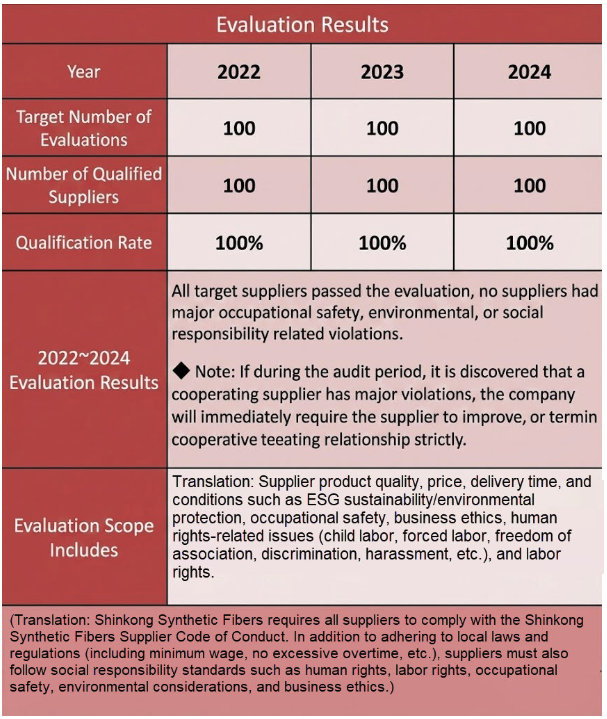
Sustainability_Policy_and_Action_Commitment_Statement
Supplier Code of Conduct
Sustainable Procurement Policy
Shin Kong Synthetic Fibers Corporation (“SSFC”) upholds the principle of sustainable management and implements sustainable procurement practices throughout the life cycle of its products and services, while taking into consideration the environmental, social, and economic impacts.
By working closely with its partners, SSFC strives to achieve reasonable costs and profitability while jointly safeguarding labor and human rights, protecting the environment, promoting business ethics and fair operations, improving procurement performance, enhancing supply chain competitiveness, and advancing toward a sustainable supply chain.
Considerations in the Procurement Process
In the procurement process, the Company takes the following factors into consideration:
- Addressing environmental issues and committing to environmental protection>
- Focusing on climate change and reducing greenhouse gas emissions>
- Managing material sources and prioritizing the use of recycled and recyclable materials>
- Complying with international standards and applicable local regulations>
- Upholding human rights and enhancing labor rights protection>
- Emphasizing occupational safety and safeguarding personnel health>
- Establishing strong business ethics and adhering to the highest standards of integrity>
- Communicating with and responding to the needs and expectations of stakeholders>
Supplier Management
The growth and success of Shin Kong Synthetic Fibers Corporation are made possible not only through the collective efforts of the Company, but also through strong partnerships with reliable suppliers. SSFC currently works with approximately 1,800 suppliers, including suppliers of raw materials, packaging materials, equipment, equipment components, and chemical additives.
In pursuit of sustainable corporate development, SSFC regards sound supplier relationships as a key success factor and seeks to work collaboratively with its partners to form a socially responsible and environmentally friendly industrial value chain. The Company aims to identify suppliers that share similar values and serve as suitable green partners.
Accordingly, SSFC requires all new suppliers to undergo due diligence reviews by relevant departments prior to formal cooperation.
Due Diligence Assessment Items Include:
- Product quality
- Technical capability
- Delivery capability
- Corporate social responsibility
(Social and environmental aspects are included in the assessment to ensure that new suppliers comply with applicable laws and regulations and meet expectations related to social responsibility, environmental protection, business ethics, and sustainability when providing products and services.)
Supplier Evaluation
The Company conducts regular performance evaluations of its existing suppliers.
The supplier evaluation results for the period 2022–2024 are summarized as follows:
(Details to be disclosed separately.)
Personal Data Protection and Privacy Policy
The Company places great importance on the protection of customer privacy and complies with the Personal Data Protection Act. It has established the Shin Kong Synthetic Fibers Personal Data Protection Management Procedures and implemented stringent personal data privacy and security management and protection measures. In addition, the Company has developed a data governance framework, including the establishment of data standards and classification, implementation of access control mechanisms, and data owner review processes, to ensure that data access and sharing are properly governed and protected, as well as to safeguard data availability, integrity, and confidentiality.
The scope of application covers the Company, its subsidiaries, operational sites, customers, and suppliers.
With respect to the collection, processing, use, and protection of personal data involved in business operations, the Company strictly complies with applicable laws and regulations. Personal data is used only within the scope permitted by law and will not be provided, leased, or otherwise disclosed to third parties. The Company implements its personal data protection management procedures in full to safeguard customer data security and privacy rights.
To further strengthen privacy risk management, the Company has established a dedicated unit responsible for overseeing the control of personal data collection, processing, and use. Through education and training, awareness programs, and audits and follow-up reviews of departments that handle personal data, the Company ensures the effective implementation of personal data protection practices.
The Shin Kong Synthetic Fibers Personal Data Protection Management Procedures are provided as an attachment.
Personal Data Protection Implementation in 2025
Incident Response and Management
- Number of incidents violating the Personal Data Protection Act: 0
No violations of personal data protection regulations occurred during the year.
Operational Audits of Personal Data Handling Departments
- Completion rate: 100%
Audits and verification were completed for the Human Resources Department, Procurement Department, Information Technology Department, Finance and Accounting Department, and all business units involved in customer interactions.
Employee Training on Personal Data Protection
- Key personnel involved in handling personal data completed personal data protection training through the Company’s online education and training platform.
- Total number of trained key personnel: 112 employees.
Internal Management and Technical Safeguards
- The Company enforces strict controls over all information access
- Information security management has been verified in terms of confidentiality, integrity, and availability, and the Company has obtained ISO 27001 certification.
| Evaluation Items | Operational Status | Differences from the “Ethical Corporate Management Best Practice Principles for TWSE/TPEx Listed Companies” and Reasons Therefor | ||||||||||||||
|---|---|---|---|---|---|---|---|---|---|---|---|---|---|---|---|---|
| Yes | No | Summary Description | ||||||||||||||
| I. Establishment of Ethical Corporate Management Policies and Programs | ||||||||||||||||
| (1) Has the Company established ethical corporate management policies approved by the Board of Directors, and clearly disclosed such policies, practices, and the commitment of the Board of Directors and senior management to the implementation thereof in its internal regulations and external documents? | ✔ | The Company has obtained Board approval for the Anti-Corruption Management Policy and the Ethical Corporate Management Best Practice Principles, which prohibit dishonest, illegal, or unethical conduct. In addition, the Company has formulated the Ethical Corporate Management Operating Procedures and Code of Conduct to ensure compliance based on reasonable and practical operational needs. | No material differences. | |||||||||||||
| (2) Has the Company established a mechanism for assessing the risk of unethical conduct, regularly analyzing and evaluating business activities with higher risks of unethical conduct within its business scope, and formulating preventive measures that at least cover the behaviors specified in Article 7, Paragraph 2 of the Ethical Corporate Management Best Practice Principles? | ✔ | The Ethical Corporate Management Operating Procedures and Code of Conduct stipulate relevant behavioral standards and establish dedicated units responsible for implementation, covering preventive measures for all specified behaviors. The Company also completes an Annual Business Ethics and Information Security Risk Assessment Form (including overseas sites) to evaluate business activities with higher risks of unethical conduct within its operating scope. |
No material differences. | |||||||||||||
| (3) Does the Company clearly specify operating procedures, codes of conduct, disciplinary actions for violations, and complaint mechanisms in its preventive measures against unethical conduct, and regularly review and revise such measures? | ✔ | The Ethical Corporate Management Operating Procedures and Code of Conduct clearly prohibit personnel from directly or indirectly providing, promising, requesting, or accepting any improper benefits. A whistleblowing mechanism has been established to encourage reporting of unethical or improper conduct. | No material differences. | |||||||||||||
| II. Implementation of Ethical Corporate Management | ||||||||||||||||
| (1) Does the Company assess the integrity records of counterparties and include ethical conduct clauses in contracts with business partners? | ✔ | The Anti-Corruption Management Policy explicitly requires the inclusion of anti-kickback clauses. The Ethical Corporate Management Best Practice Principles serve as compliance guidelines. Contracts with suppliers include a Supplier Code of Conduct, requiring suppliers to sign a Social Responsibility and Supplier Code of Conduct Commitment Statement. |
No material differences. | |||||||||||||
| (2) Has the Company established a dedicated unit under the Board of Directors to promote ethical corporate management, and does it report at least annually to the Board on policy implementation and preventive measures? | ✔ | Under the Ethical Corporate Management Operating Procedures and Code of Conduct, the General Management Division serves as the Ethical Corporate Management Promotion Task Force, responsible for policy promotion, education and training, and handling whistleblowing cases. The Company conducts annual reporting to the Board. Ethical management training for employees was conducted on February 26, 2025, and the annual implementation and promotion status was reported to the Board on March 10, 2025. |
No material differences. | |||||||||||||
| (3) Has the Company established policies to prevent conflicts of interest and provided appropriate reporting channels? | ✔ | The Business Ethics Policy and the Ethical Corporate Management Operating Procedures and Code of Conduct clearly define conflict-of-interest prevention policies and establish dedicated complaint and whistleblowing hotlines. | No material differences. | |||||||||||||
| (4) Has the Company established effective accounting and internal control systems, and does the internal audit unit formulate audit plans based on risk assessments of unethical conduct or engage CPAs to conduct audits? | ✔ | The Company’s accounting system, internal control system, and internal audit operations are conducted in accordance with relevant regulations and are reported to the Board of Directors. | No material differences. | |||||||||||||
| (5) Does the Company regularly conduct internal and external training on ethical corporate management? | ✔ |
During the current year, ethical corporate management and insider trading prevention briefings were conducted for senior management, supervisors, and employees at management meetings. Factories and departments also conducted ethics and compliance (anti-corruption and anti-bullying) training during Employee Care Days. Training Summary:
|
No significant differences | |||||||||||||
| Ⅲ. Operation of the Company’s Whistleblowing System | ||||||||||||||||
| (1) Has the Company established specific whistleblowing and reward systems, convenient reporting channels, and designated appropriate personnel to handle reports? | ✔ |
1.The Company has established the Business Ethics Management Procedure, Anti-Corruption Management Policy, and Whistleblowing, Complaints, Suggestions, and Employee Participation & Feedback Management Procedure.
2.Reporting channels are publicly disclosed on the Company website. Based on the nature of the report, a dedicated unit is assigned to handle the case in accordance with procedures, and an investigation task force is established where necessary. |
No significant differences | |||||||||||||
| (2) Has the Company established standard operating procedures for investigations, post-investigation measures, and confidentiality mechanisms? | ✔ | The Whistleblowing, Complaints, Suggestions, and Employee Participation & Feedback Management Procedure specifies handling procedures, and the Whistleblower Protection and Anti-Retaliation Management Procedure ensures confidentiality of whistleblower identities and content. | No material differences. | |||||||||||||
| (3) Has the Company implemented measures to protect whistleblowers from retaliation? | ✔ |
1.The Whistleblower Protection and Anti-Retaliation Management Procedure guarantees confidentiality and protection against improper treatment.
2.In fiscal year 2025, the Company received zero (0) whistleblowing cases. |
No material differences. | |||||||||||||
| IV. Enhancement of Information Disclosure | ||||||||||||||||
| Does the Company disclose its Ethical Corporate Management Best Practice Principles and implementation results on its website and the Market Observation Post System? | ✔ |
1.The Company has completed a Compliance Manual, distributed it internally, and disclosed ethical management information on internal knowledge platforms and the Company website.
2.In fiscal year 2025, there were no violations of ethical corporate management principles or corruption incidents. |
No material differences. | |||||||||||||
|
V. Differences Between the Company’s Ethical Corporate Management Practices and the Ethical Corporate Management Best Practice Principles
The Company has established the Ethical Corporate Management Best Practice Principles and the Ethical Corporate Management Operating Procedures and Code of Conduct, and operates in accordance therewith. There are no differences between actual operations and the established principles. |
||||||||||||||||
|
VI. Other Important Information Helpful for Understanding the Company’s Ethical Corporate Management Practices
The Company has formulated the Ethical Corporate Management Operating Procedures and Code of Conduct, defining behavioral standards, establishing dedicated units, and effectively implementing related operations. |
||||||||||||||||